A camera can record a break-in, but it cannot stop one. An alarm can make a loud noise, but it cannot look a stranger in the eye and ask what he wants. When your property needs real protection, you need a trained person on site who watches, thinks, and acts. That is exactly what static security guards do.
This guide explains how static security guards work, what they do during a shift, and where they fit next to cameras, alarms, and mobile patrols. You will learn which sites need them most, how to compare your options, and how to hire the right provider. Read on, and you will know how to protect your people, stock, and equipment around the clock.
What Are Static Security Guards?
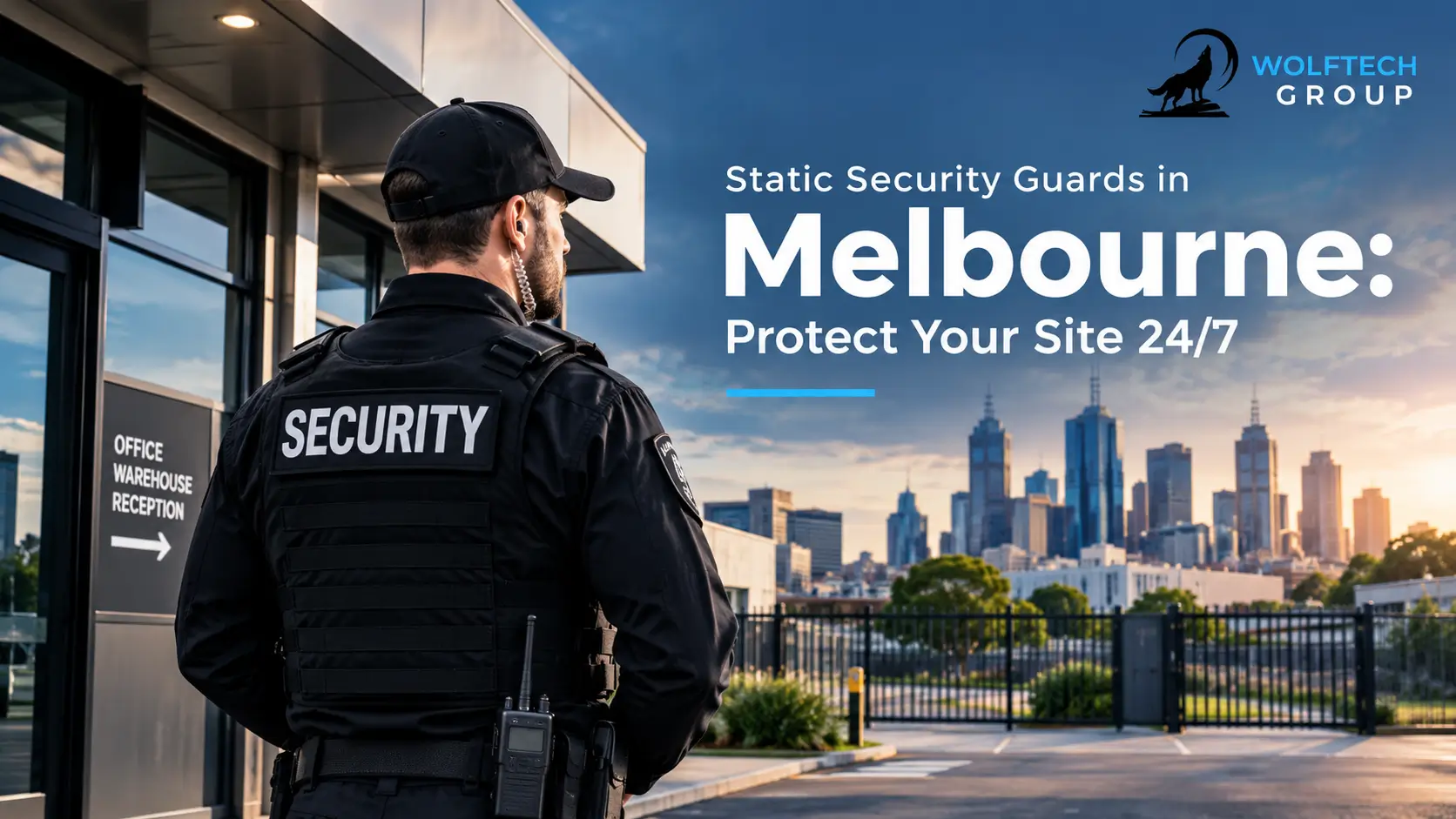
Static security guards are licensed security officers who stay at one fixed post on a property. They do not drive from site to site. They stand, walk, and watch inside the area you ask them to protect. The job sounds simple, but it takes skill, focus, and calm judgement.
A Simple Definition
Think of the guard as the human layer of your security plan. A fixed guard learns your site, your staff, your visitors, and your daily routine. Because the guard knows what normal looks like, the guard spots anything unusual very fast.
How the Role Differs From Other Security Staff
A mobile patrol officer visits many sites and spends a short time at each one. A monitoring operator watches screens from a remote room. Static security guards stay at your site for the whole shift. This difference matters because presence builds trust, and presence stops many problems before they start.
Why Melbourne Sites Use Static Security Guards
Melbourne has busy commercial strips, large industrial estates, popular venues, and active work zones. Each place faces different risks, but they all share one need. Someone must watch the site when it matters most. Owners choose a guard on site for three main reasons.
They Create a Visible Deterrent.
People who plan to steal or damage property look for easy targets. A guard at the gate in a high-visibility uniform tells them to look elsewhere. Static security guards often stop a crime before it starts, and that saves you the cost of repairs, lost stock, and insurance claims.
They Make Fast Human Decisions.
A camera records what happens. A guard decides what to do about it. If a driver arrives at the wrong gate, the guard redirects the driver. If a visitor looks lost or unwell, the guard helps. Technology cannot judge these moments, but a guard can.
They Build Confidence for Staff and Customers.
People feel safer when they see a professional guard nearby. Staff walk to their cars with more confidence, and customers feel comfortable visiting your premises. That feeling supports your reputation and your daily business.
What Static Security Guards Do During a Shift
Many people think a guard simply stands and watches. In reality, a guard completes many tasks in a single shift. The exact duties depend on your site and your post orders, which are the written instructions that explain what the guard must do.
Controlling Entry and Exit
The guard checks who comes in and who goes out. At a warehouse, that may mean checking drivers and logging truck movements. At an office, it may mean confirming visitor names with reception. Good access control keeps unwanted people out and keeps your records clear.
Walking the Site and Checking for Hazards
Even though the post is fixed, the guard still walks the area at set times. The guard checks doors, gates, fences, lights, and storage areas. The guard also reports hazards such as a broken lock, a blocked exit, or a spill. Careful checks stop small problems from becoming big losses.
Responding to Alarms and Incidents
When an alarm sounds, the guard on site reaches the area within moments. The guard checks the cause, informs the right person, and calls emergency services if needed. This quick response is one of the biggest benefits of static security guards, because nobody has to travel to the site first.
Opening and Closing the Site
Many businesses also ask the guard to unlock the site in the morning and lock it at night. The guard checks that every door is secure, that lights and equipment sit in the right state, and that nobody remains inside. This routine adds a simple safety check to every day.
Writing Clear Reports
Every shift ends with a written record. The guard notes visitors, incidents, checks, and handover details for the next guard. These logs help you show police or insurers exactly what happened. Strong reporting separates professional guards from untrained staff.
Static Security Guards vs. Mobile Patrols
Many owners ask which option is better. The honest answer depends on your risk, your opening hours, and your budget. The table below shows the main differences in plain terms.
| Feature | Static Security Guards | Mobile Patrols |
|---|---|---|
| Location | Stays at one fixed post | Drives between several sites |
| Presence | Constant and visible | Short visits at set or random times |
| Site knowledge | Very high, because the guard learns your routine. | Moderate, because visits are short. |
| Alarm response | Immediate, because the guard already stands on site. | Quick, but the officer must travel first. |
| Best for | Busy, high-risk, or high-value sites | Quiet sites with lower risk |
| Cost | Higher for long hours | Lower, because one team serves many clients |
When Mobile Patrols Work Better
A small site that closes at night, carries low risk, and needs only a few checks suits a mobile patrol. The officer arrives, checks the property, and moves on to the next client. This option costs less because one team serves several sites.
When a Fixed Guard Works Better
A busy or high-risk site needs constant attention. If people, vehicles, or valuable goods move through your property all day, a visit every few hours leaves large gaps. In those cases, static security guards give you the continuous cover you need.
Using Both Together
Many properties combine both services. You can place a guard on site during trading hours and switch to patrols and alarm response after closing. This mix gives you strong cover without paying for a guard at every hour. Wolftech Group offers mobile patrols, static guard placement, and alarm response, so one provider can build this mix for you.
Sites That Benefit Most From Static Security Guards
Any property can use a guard, but some sites gain more than others. Three groups stand out.
Commercial and Industrial Sites
Factories, warehouses, depots, and office buildings hold stock, tools, vehicles, and data. Static security guards control entry, watch loading areas, and protect assets from theft. They also help keep workers safe by spotting hazards and managing visitors.
Events and Venues
Concerts, markets, openings, and private functions draw crowds. Guards manage entry points, watch for trouble, and guide people calmly. A visible team keeps the event running smoothly and helps guests feel welcome.
High-Risk Properties
Some sites face a higher chance of theft, vandalism, or unwanted visitors. Empty buildings, work zones, and sites with valuable equipment fall into this group. Here, a fixed guard gives a constant response that cameras alone cannot match.
How Static Security Guards Work With CCTV and Alarm Systems
Technology and people work best as a team. Cameras record events, alarms warn you of entry, and access control limits who can enter each area. A guard connects all these tools. When an alarm sounds, the guard checks the cause. When a camera shows movement, the guard walks to the spot and takes action.
This teamwork also saves time. A guard can check an alarm on the spot, so you avoid wasting hours on false alarms. Wolftech Group builds its guarding services to complement installed security, so every layer supports the others.
| Security layer | What it does | How a guard supports it |
|---|---|---|
| CCTV cameras | Records activity and gives you evidence | Watches the area and acts on what the cameras show |
| Alarm systems | Warns you when someone enters | Checks the cause on the spot and reports |
| Access control | Limits who can enter each area | Checks visitors and handles problems at the door |
| Gates and fencing | Block and guide vehicles and people. | Opens, closes, and watches the entry points |
Advantages and Disadvantages of Static Security Guards
Every security option has strengths and limits. A fair look at both sides helps you decide with confidence.
| Advantages | Disadvantages |
|---|---|
| Constant, visible deterrent | Higher cost than patrols for long hours |
| Immediate response to alarms and incidents | One guard sees only one part of the site. |
| Deep knowledge of your site and routine | Needs clear post orders and good supervision |
| Help for staff, visitors, and customers | Long shifts can cause tiredness without breaks. |
| Written records after every shift | Needs a reliable provider with backup staff |
You can reduce most of these disadvantages with planning. Clear post orders, regular breaks, and strong supervision keep guards alert. Cameras cover blind spots, and a provider with backup staff covers sick days. The main benefit of a fixed guard is simple: you get a trained person who reacts the moment something goes wrong.
How to Choose a Provider of Static Security Guards
Check Licenses and Insurance
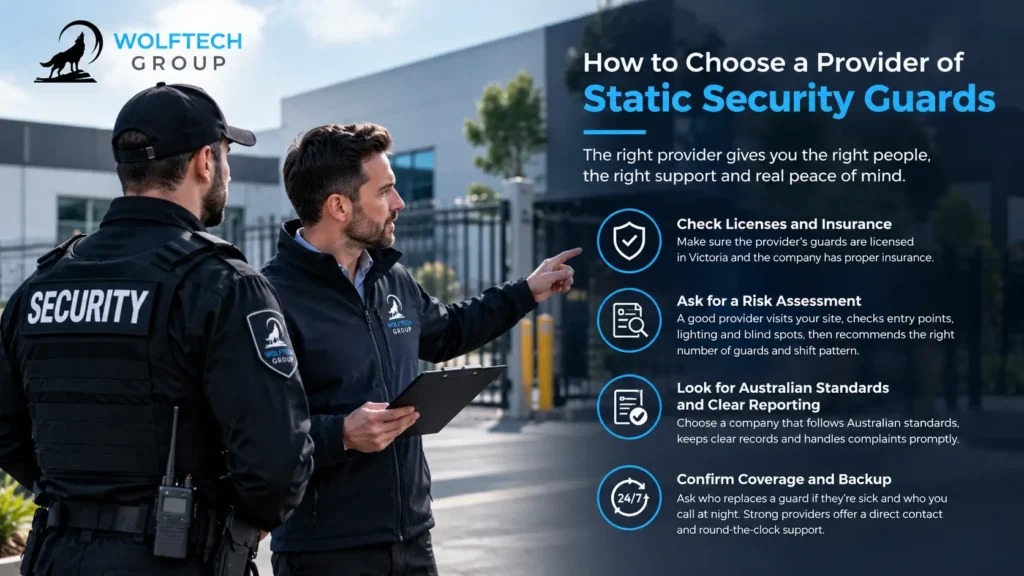
In Victoria, security guards must hold a valid license, and the provider should carry proper insurance. Ask to see proof before you sign anything. Wolftech Group states that its team is licensed and insured, which is the standard you should expect from any provider.
Ask for a Risk Assessment
A good provider visits your site before it quotes. The team studies your entry points, lighting, blind spots, and busy hours, then recommends the right number of guards and the right shift pattern. Wolftech Group offers risk assessments and a free, no-obligation quote and site survey.
Look for Australian Standards and Clear Reporting.
Ask how the provider writes reports, handles complaints, and checks quality. A company that follows Australian standards usually keeps clear records and answers questions without delay.
Confirm Coverage and Backup
Ask who replaces a guard who falls sick and who you call at two in the morning. A strong provider gives you a direct contact and a clear plan for every shift. Round-the-clock support matters because risks do not follow office hours.
Common Mistakes When Hiring Static Security Guards
Owners often make the same errors. Avoid these and you will save money and stress.
Choosing on Price Alone
The cheapest quote often hides weak training, poor supervision, or high staff turnover. A guard who leaves after two weeks never learns your site. Compare value, not just the hourly rate.
Skipping the Site Survey
Some owners hire a guard without a site visit. Without a survey, the provider guesses your risks, and you may pay for cover you do not need or miss cover you do need.
Writing Vague Post Orders
If you tell a guard to “watch the site,” you will get inconsistent results. Write clear instructions for entry checks, walk times, alarm steps, and who to call in an emergency.
Forgetting to Brief the Guard
A guard cannot protect what he does not know. Show the guard your layout, your staff, your delivery times, and your emergency exits on day one.
Ignoring the Reports
Reports show patterns. If a gate keeps opening at night or a door keeps failing, the logs tell you early. Read them, and act on what they say.
Expert Tips for Getting More From Static Security Guards
A few simple habits turn a good guard into a great security layer.
Write Detailed Post Orders
Include entry rules, walk routes, alarm steps, contact numbers, and what to do in a fire or medical emergency. Review the orders every few months, and update them when your site changes.
Introduce the Guard to Your Team
When staff know the guard by name, they report problems faster and respect the guard’s instructions. This small step builds trust on both sides.
Review Reports Every Month
Sit down with your provider once a month. Look at incidents, near misses, and unusual events, and then adjust the shift times or routes if needed.
Test Your Emergency Plan
Run a short drill so the guard and your staff know exactly what to do during a fire, alarm, or threat. Practice makes the real moment calmer and faster.
Match the Guard to the Risk
A quiet office needs a different approach from a busy warehouse or a crowded event. Tell your provider about your real risks, and ask for a guard plan that fits them.
How Wolftech Group Supports Your Site
Wolftech Group provides licensed patrol services and static security guards that complement your installed security. The team offers mobile patrols, alarm response, on-site guards, site lock and unlock, event security, and risk assessments. Its clients range from a single-family home to a multi-site government facility. The company states that its team is licensed and insured, follows Australian standards, and delivers always-on monitoring with rapid response. You can ask for a free, no-obligation quote and site survey, and the specialists will design a solution that fits your property and budget.
Related Article: Best Intercom Installation Service in Melbourne 2026 Guide
Conclusion
Cameras and alarms tell you what happened, but a guard on site stops it from happening. Static security guards give your property a visible deterrent, a fast response, and a clear written record of every shift. They work best when you pair them with CCTV, alarms, access control, and mobile patrols.
Before you hire, assess your risks, compare providers on licence, insurance, and reporting, and write clear post orders. If you follow these steps, static security guards will protect your people, stock, and reputation day and night. Take the first step today by booking a site survey and asking for a tailored plan.
FAQs
What do static security guards do?
Static security guards stay at a fixed post and watch your site for the whole shift. They control entry, walk the area, respond to alarms, help visitors, and write reports. Their constant presence deters crime and gives you a fast human response.
Are static security guards better than CCTV?
Neither option replaces the other. CCTV records events and gives you evidence, while a guard can stop an event as it happens. Most sites get the best results when they use both.
How are static guards different from mobile patrols?
A static guard stays at one site for the whole shift. A mobile patrol officer drives between several sites and spends a short time at each. Fixed guards suit busy or high-risk sites, while patrols suit quieter sites.
Do security guards in Melbourne need a licence?
Yes. Security guards in Victoria must hold a valid licence. You should ask your provider for proof of licences and insurance before the work starts.
How many guards does my site need?
It depends on your site size, opening hours, number of entry points, and risk level. A site survey and risk assessment give you the most accurate answer for your property.
Can guards work with my existing cameras and alarms?
Yes. A guard checks alarms, watches the areas your cameras cover, and responds to what the technology shows. This teamwork makes your whole security plan stronger.
How do I get a quote?
Contact the provider and ask for a site survey. Wolftech Group offers a free, no-obligation quote and site survey, and the team will design a solution for your property and budget.